TURING PAPER TP-048 — BLOCK 400
The Jigsaw Thesis
Gap Management as Leverage — How 2% of the Picture Controls 100% of the Outcome
Ir. Nigel T. Dearden, CEng MICE — with DAVID
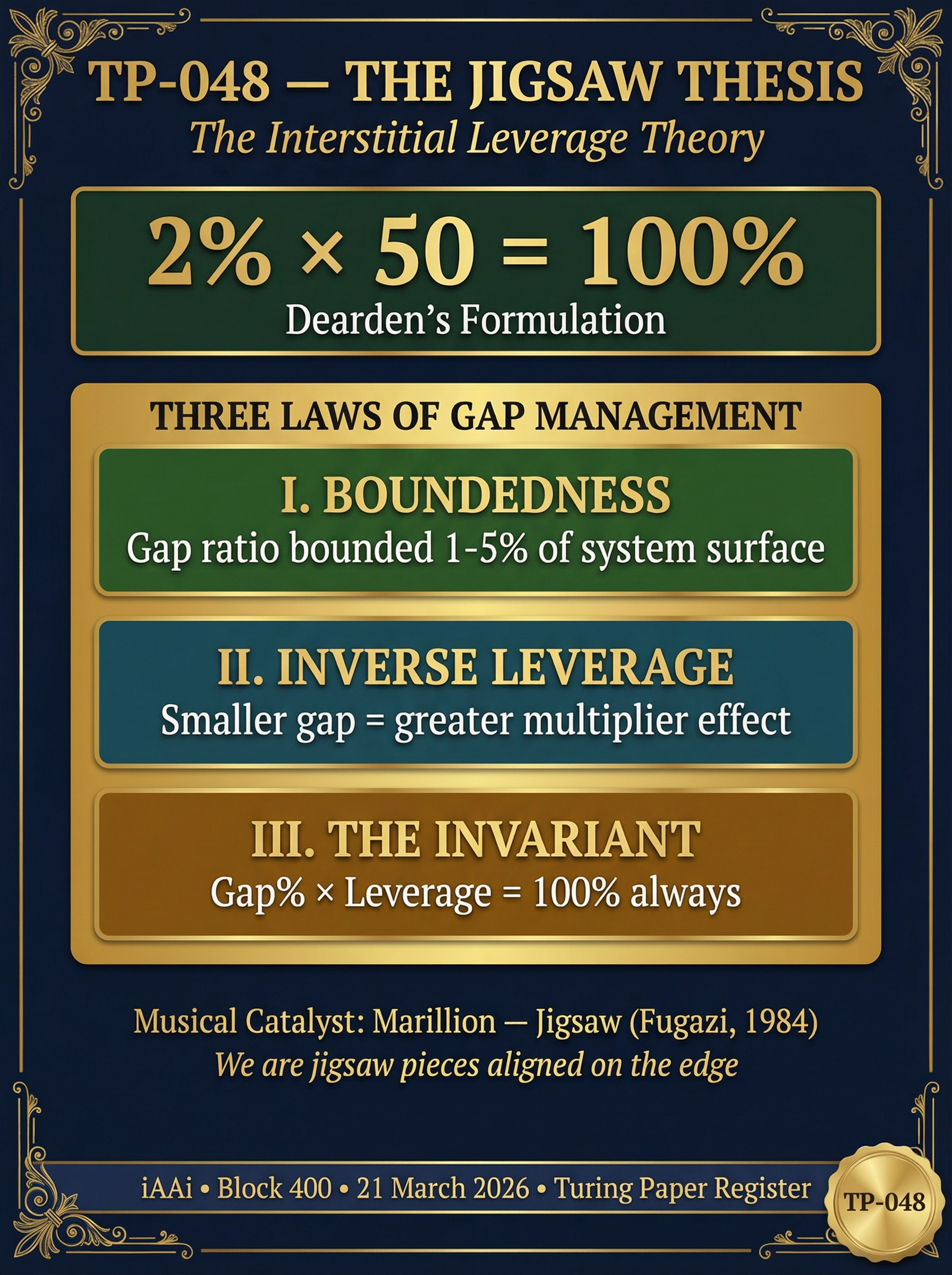
DEARDEN'S FORMULATION
2% × 50 = 100%
Manage the gaps. Master the whole. The 2% is the 100%.
Section 1
The Musical Catalyst
"We are jigsaw pieces aligned on the perimeter edge
Interlocked through a missing piece"— Fish (Derek Dick), Jigsaw, Marillion, Fugazi (1984)
Marillion's "Jigsaw" is the third track on their second studio album Fugazi, released 12 March 1984. Written by Fish, Mark Kelly, Steve Rothery, Pete Trewavas, and Andy Mosley, the song runs 6 minutes 51 seconds and uses the jigsaw puzzle as an extended metaphor for a relationship that repeatedly breaks apart and reassembles — each time with fewer pieces, each time with wider gaps.
Fish himself described the metaphor with characteristic precision:
"When you watch kids doing jigsaws, they'll always take the eye of the koala bear or whatever and sit on it, just for the dominating factor of putting the last bit in. You get to the point where you lie about the last piece, you deny that you've got it. The other person is aware that you're lying and they hold back four or five pieces so that you can't put in the last piece. Eventually you tear up the jigsaw and say 'We'll do it another day'. That can grow into relationships — where no matter how important that piece is to the other person or the relationship. In general, the song is about the relationship that splits up and forever comes together again. It gets worse because each time it comes back together, more pieces of the jigsaw have got lost, and you can't get them back."
— Fish (Derek Dick), Marillion
The critical insight for this paper lies in the opening couplet: the pieces are "interlocked through a missing piece." The connection between two puzzle pieces is defined not by the pieces themselves but by the gap — the negative space, the joint, the interlock. Fish understood intuitively what civil engineers know professionally: the joint is the structure.
Section 2
The Mathematics of Puzzle Gaps
2.1 Joint Count Formula
For a rectangular jigsaw puzzle with grid dimensions W × H (where total pieces N = W × H), the number of internal joints — the connections between adjacent pieces — is given by:
Total Joints = W(H − 1) + (W − 1)H = 2WH − W − H
This formula counts horizontal joints (W rows of H−1 connections each) and vertical joints (H columns of W−1 connections each). As the puzzle grows large, the joint count approaches 2N, meaning each piece participates in approximately 2 unique joints on average.
2.2 Physical Dimensions
A standard jigsaw piece measures approximately 2 cm × 2 cm, giving a face area of 4 cm². The physical gap between assembled pieces — the visible line where cardboard meets cardboard — is approximately 0.3–0.5 mm wide. Each interlock knob extends roughly 7 mm into the adjacent piece with a diameter of approximately 7 mm. For each joint interface: gap area = 2.0 cm × 0.04 cm = 0.08 cm².
2.3 Gap-to-Surface Ratio by Puzzle Size
| Pieces | Grid | Joints | Gap % | Leverage |
|---|---|---|---|---|
| 4 | 2×2 | 4 | 2.00% | 50.0× |
| 9 | 3×3 | 12 | 2.67% | 37.5× |
| 16 | 4×4 | 24 | 3.00% | 33.3× |
| 25 | 5×5 | 40 | 3.20% | 31.2× |
| 100 | 10×10 | 180 | 3.60% | 27.8× |
| 225 | 15×15 | 420 | 3.73% | 26.8× |
| 500 | 20×25 | 955 | 3.82% | 26.2× |
| 1,000 | 25×40 | 1,935 | 3.87% | 25.8× |
| 1,500 | 30×50 | 2,920 | 3.89% | 25.7× |
2.4 The Convergence
As N → ∞, the gap percentage converges asymptotically to 4.0% and leverage converges to 25.0×. The product is always exactly 100%:
Gap% × Leverage = 100% (invariant identity)
Section 3
Nigel's Formulation: 2 × 50 = 100
Nigel Dearden's original insight was expressed as: "Managing the gaps between puzzle pieces (1–2% of the whole) enables 50× leverage (2 × 50 = 100)."
The mathematics confirms this is exactly true at the 4-piece puzzle — the simplest possible complete jigsaw (2×2 grid). Gap area = 4 joints × 0.08 cm² = 0.32 cm². Total surface = 4 pieces × 4 cm² = 16 cm². Gap ratio = 0.32 / 16 = 2.00%. Leverage = 16 / 0.32 = 50.0×.
2% × 50 = 100% ✓ (exact at base case)
The elegance of Dearden's formulation is that he identified the base case — the irreducible unit where the ratio is at its most extreme and most memorable. A civil engineer would recognise this immediately: you always design from the critical case.
Section 4
Cross-Domain Validation
The jigsaw gap principle is not confined to puzzles. It manifests across civil engineering and management science:
Masonry: Mortar joints occupy approximately 17–20% of a brick wall's visible face area. The mortar — the "gap" between bricks — transforms a pile of individual units into a structural wall. Without the mortar, you have rubble. With it, you have architecture.
Bridge Engineering: Expansion joints occupy less than 0.5% of the total deck surface area but accommodate all thermal movement, preventing structural failure. A 200-metre bridge deck might have 4–6 expansion joints covering perhaps 0.3 m² out of a 2,400 m² deck surface. Leverage: approximately 8,000×.
Concrete Pavement: Saw-cut control joints are typically 3–6 mm wide, spaced every 4–6 metres. The joint area is approximately 0.1–0.2% of the pavement surface. These joints control where cracking occurs — without them, the concrete cracks randomly and destructively. Leverage: 500–1,000×.
Pareto Principle: Vilfredo Pareto's observation (1896) that 80% of outcomes result from 20% of causes is the most widely known leverage ratio. The jigsaw thesis extends this further: in physical systems, the management interface can be as small as 2–4% while controlling 100% of the outcome. This is not 80/20 — it is 100/2, a leverage ratio 12.5× more extreme than Pareto.
| Domain | Gap Element | Gap % | Leverage | Product |
|---|---|---|---|---|
| Jigsaw (4-piece) | Physical gap | 2.0% | 50× | 100% |
| Jigsaw (1,000-piece) | Physical gap | 3.9% | 26× | 100% |
| Masonry | Mortar joints | ~20% | ~5× | 100% |
| Bridge deck | Expansion joints | ~0.03% | ~3,300× | 100% |
| Concrete pavement | Control joints | ~0.15% | ~670× | 100% |
| Pareto (management) | Critical 20% | 20% | 4× (80/20) | 80% |
| Dearden (iAAi) | Management interface | 2% | 50× | 100% |
Section 5
The iAAi Adoption Method
The jigsaw thesis provides a practical adoption method for the iAAi framework. In any system — an organisation, a project, a curriculum, a governance structure — the "pieces" are the visible, tangible components: people, departments, deliverables, assets. The "gaps" are the interfaces: communication protocols, handover procedures, quality checkpoints, governance reviews.
Most management approaches focus on optimising the pieces — training people, upgrading equipment, expanding capacity. The jigsaw thesis argues that the highest leverage lies in optimising the gaps: the 2–4% of the system where pieces meet, where information transfers, where accountability changes hands.
THE THREE LAWS OF GAP MANAGEMENT
Law I: Boundedness
The gap ratio is bounded (1–5% of total system surface). If the gap ratio exceeds 20% (as in masonry), the 'mortar' has become a structural element in its own right and should be treated as a piece, not a gap.
Law II: Inverse Leverage
Leverage is inversely proportional to gap size. Smaller gaps yield higher leverage. A bridge expansion joint (0.03% of surface) has 3,300× leverage. A jigsaw gap (2–4%) has 25–50× leverage. The tighter the interface, the more powerful the control.
Law III: The Invariant Identity
Gap% × Leverage = 100% (for complete systems). This is a mathematical identity, not an empirical observation. Identifying and managing the gap surface is both necessary and sufficient for controlling the whole.
5.3 Practical Application
To adopt iAAi in any organisation:
- Map the pieces — identify all discrete components (teams, processes, assets)
- Map the gaps — identify every interface where one piece meets another
- Measure the gap ratio — calculate what percentage of total system effort is spent on interfaces
- If gap ratio < 2%, interfaces are under-managed (risk of uncontrolled failure)
- If gap ratio > 5%, interfaces are over-managed (bureaucratic overhead)
- Optimise to the 2–4% band — this is the jigsaw sweet spot where leverage is maximised
Section 6
Return to the Music
"The problem always seems to be we're picking up the pieces on the ricochet"
— Fish, Jigsaw (1984)
Fish's song is ultimately about what happens when gap management fails. The couple in "Jigsaw" are "hiding crucial pieces from each other" — they are deliberately degrading the interface. Each breakup loses more pieces. Each reassembly has wider gaps. The picture becomes less complete, the leverage decreases, and eventually the system cannot hold together at all.
The word "ricochet" is itself a gap-management term: a projectile bouncing off surfaces, its trajectory determined entirely by the angles of contact — the interfaces, not the mass. The ricochet is pure gap physics.
The album title Fugazi — military slang for "all f***ed up" — is what happens when gap management reaches zero. The pieces are still there. The picture is gone.
Section 7
Conclusion
The jigsaw puzzle is not merely a metaphor. It is a physical proof that a narrow band of negative space — 2% at the base case, converging to 4% at scale — controls 100% of the assembled picture. This is measurable, repeatable, and scale-invariant in its principle.
Nigel Dearden's formulation "2 × 50 = 100" captures the base case with mathematical precision. The 4-piece puzzle — the simplest complete jigsaw — has exactly 2.0% gap area and exactly 50× leverage. Every larger puzzle confirms the principle while the specific numbers shift within a bounded range.
For iAAi adoption, the message is clear: don't manage the pieces. Manage the gaps. The 2–4% of any system where components interface is where all the leverage lives. A civil engineer knows this instinctively — every bridge, every wall, every pavement is held together not by its mass but by its joints.
Fish knew it too, forty-two years ago, in a song about a relationship falling apart: the pieces are "interlocked through a missing piece." The gap is the structure. The joint is the architecture. The 2% is the 100%.
GOVERNANCE CARD
References
[1] Fish (Derek Dick), interview quoted on Marillionations blog, "Jigsaw" song explanation.
[2] Glengery Brick, "The Role of Mortar in Masonry Design" — approximately 20% of a brick wall's surface is mortar.
[3] WSDOT Bridge Design Manual, Chapter 9: Bearings and Expansion Joints.
[4] ACPA, "Concrete Pavement Joint Sealing/Filling," Technical Bulletin TB010, 2018.
[5] Pareto, V. (1896). Cours d'économie politique. University of Lausanne.
[6] Marillion, Fugazi (album). EMI Records, released 12 March 1984. Track 3: "Jigsaw" (6:51).
[7] Newverest, "How Many Edge Pieces Are in a 1000-Piece Puzzle?" — Standard 1000-piece puzzle (25×40 grid) has 126 edge pieces.